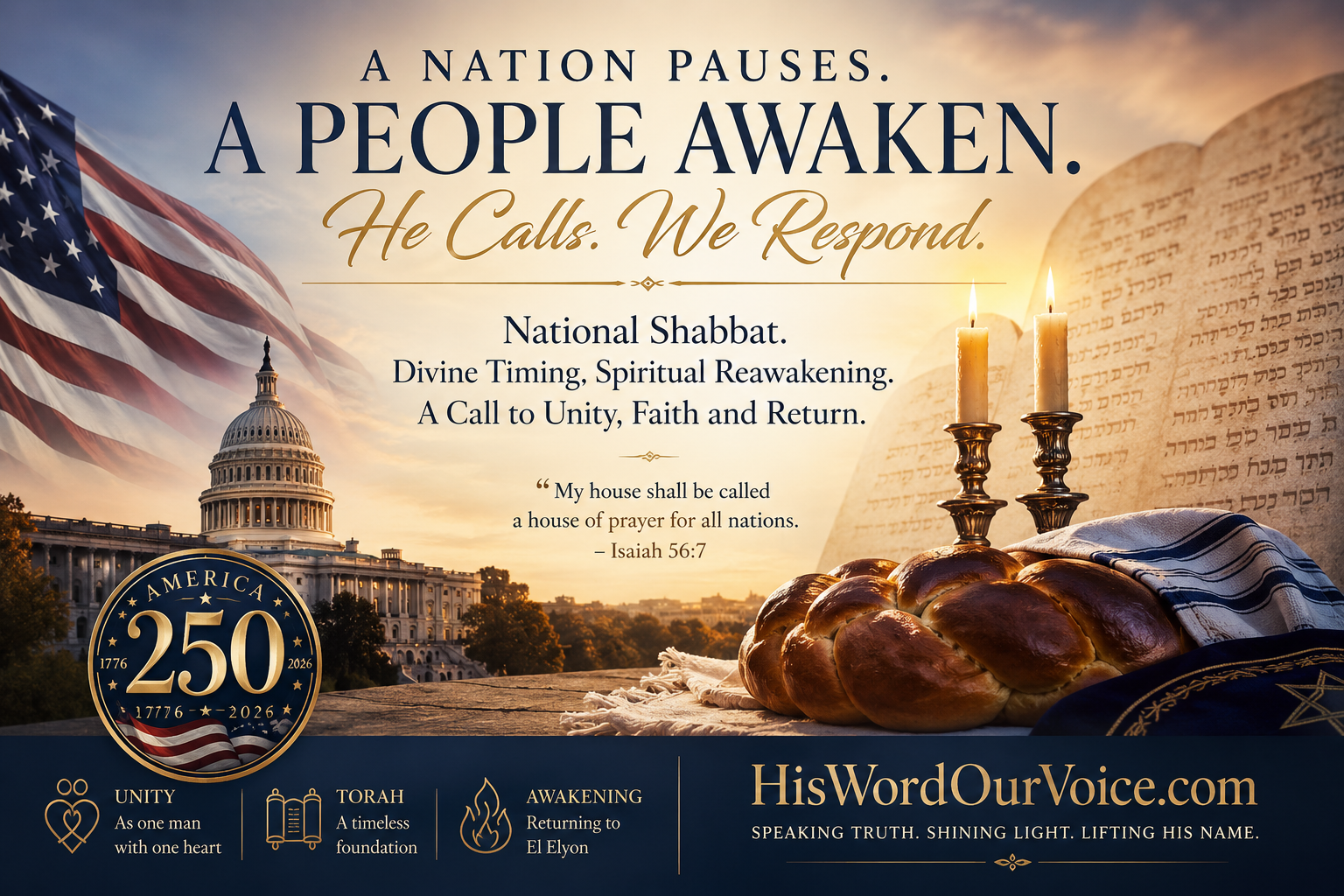
There is much that could be said about the meaning and beauty of Sabbath rest. But this article focuses specifically on the significance of a sitting President of the United States, President Trump, declaring a National Shabbat in honor of America’s 250th anniversary—and the remarkable timing surrounding that declaration.
To my knowledge, there has never been a proclamation of this kind from the highest office in the nation. During a weekend set aside for prayer, praise, and thanksgiving, the President encouraged Jewish Americans to observe a national Sabbath and called on friends, families, and communities of every background to come together in gratitude.
Why is this so significant?
1. Unity — The Sabbath Before Shavuot
The Sabbath preceding Shavuot carries special meaning within Jewish tradition. This Shabbat is known as Shabbat Bamidbar, because the Torah portion Bamidbar (“In the Wilderness”) is read on that day.
Rabbi Menachem M. Schneerson emphasized this Shabbat as a global Shabbat of unity, rooted in the idea that Israel received the Torah at Sinai “as one man with one heart.” Since Shavuot celebrates the giving of the Torah, the Sabbath before it becomes a fitting time to prepare hearts in unity before the Lord.
Even as both Jewish and Gentile communities reflect on this proclamation, it is noteworthy that the traditional spiritual significance of this particular Shabbat centers on unity.
In a time marked by division, conflict, and unrest, the call to pause together before God carries profound spiritual weight.
2. The Significance of Keeping Two Shabbats
According to Rabbi Chaim Lazaroff, there is a long-held Jewish teaching that if the Jewish people were to faithfully keep two consecutive Shabbats, Messiah would come.
With this proclamation encouraging widespread observance of Shabbat on May 15–16, followed immediately by the expectation that many will also observe the Shabbat connected to Shavuot—a major biblical festival—the sequence prophetically aligns with this concept of “keeping two Shabbats.”
Whether one views this symbolically, spiritually, or prophetically, the timing is striking.
For believers in Jesus as Messiah, it also serves as a reminder to watch, pray, and discern the times with humility and reverence.
3. A Reawakening of Jewish Spirituality
An insightful opinion piece in the Jerusalem Post highlights a growing concern that “parts of modern Jewish culture increasingly treat Shabbat as expendable.”
The author describes a post–October 7 resurgence of Jewish identity, often expressed through the Star of David and the flag of Israel. Yet she also recognizes that cultural identity alone is not enough.
She writes:
“A Jewish star without Judaism eventually becomes jewelry. A map of Israel without Torah eventually becomes geography.”
That statement is deeply sobering.
The article acknowledges that civilizations are not preserved merely by symbols or aesthetics. Jewish survival through centuries of persecution, pogroms, terrorism, and genocide has been sustained by covenant faithfulness and practices such as Shabbat.
While the author does not explicitly speak of Adonai in personal terms, she recognizes that culture alone cannot sustain a people. Judaism—with Shabbat at its center—remains foundational to Jewish identity and continuity.
Perhaps most striking is her observation that many across diverse Jewish communities have been awakened to reconsider the significance of Shabbat because of a proclamation issued by a Gentile President of the United States.
May this become more than cultural reflection.
May it become the beginning of a deeper spiritual awakening—a turning back to El Elyon, the Most High God.
4. The Impact on a Gentile Nation
Isaiah 56:6–7 declares:
“Also the sons of the foreigner
Who join themselves to the LORD, to serve Him,
And to love the name of the LORD, to be His servants—
Everyone who keeps from defiling the Sabbath,
And holds fast My covenant—
Even them I will bring to My holy mountain,
And make them joyful in My house of prayer…
For My house shall be called a house of prayer for all nations.”
The Sabbath was never merely about ritual. It is an invitation into God’s presence, His rest, and covenant relationship with Him.
Isaiah’s prophecy reminds us that the invitation extends beyond Israel to all who would join themselves to the Lord in faithfulness and worship.
For a Gentile nation such as America to publicly acknowledge the value of Sabbath—even symbolically—is significant. It points beyond politics and toward a deeper spiritual hunger many may not yet fully recognize.
A Prophetic Intersection of Timing
There appears to be a unique intersection of timing unfolding—one that points toward spiritual reawakening, repentance, prayer, and harvest.
So as you read or hear about these events, perhaps the most important question is this:
What is my role? What is my response?
The answer may begin with something simple, yet profound:
Pause. Reflect. Repent. Return to God. Pray. Praise Him.
And honor the Lord of the Sabbath—Jesus the Messiah—so that you may find rest for your soul.
Leave a Reply