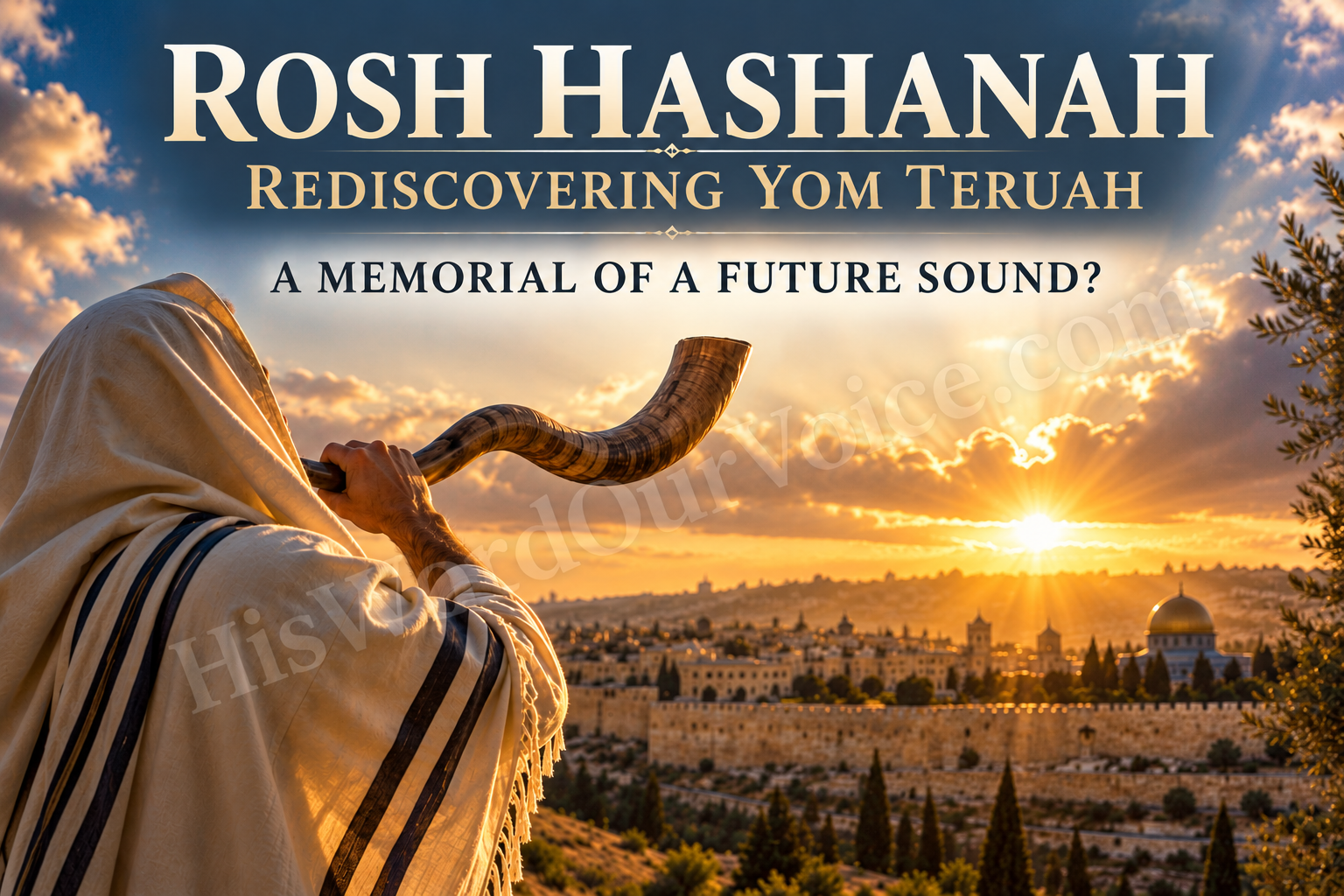
A Memorial of a Future Sound?
Most people know the first day of Tishrei as Rosh Hashanah, the Jewish New Year. But that is not the name Scripture gives this appointed time. In the Torah, it is Yom Teruah — the Day of Teruah.
“In the seventh month, on the first day of the month, you are to have a Shabbat rest, a memorial of blowing [zikhron teruah], a holy convocation.”
— Leviticus 23:24 TLV
The Hebrew word teruah (תְּרוּעָה) is often associated with the blast of a shofar, but it does not simply mean “trumpet.” It describes the sound itself: a loud shout, alarm, battle cry, joyful acclamation, or commanding blast. A shofar can produce a teruah, but so can the human voice.
That distinction opens up the meaning of this feast considerably.
The Mystery of the Memorial
There is something unusual about God’s command concerning Yom Teruah.
When God establishes other memorials, the event being remembered is often clear. Passover memorializes God’s deliverance of Israel from Egypt. Unleavened Bread recalls their hurried departure. Sukkot reminds future generations that God caused Israel to dwell in booths after bringing them out of Egypt.
But when God commands Yom Teruah, He calls it:
זִכְרוֹן תְּרוּעָה — zikhron teruah
“a memorial/remembrance of teruah.”
Yet He never tells Israel what historical event the teruah is memorializing.
Certainly, Israel had already heard the terrifying sound of the shofar when ADONAI descended upon Mount Sinai (Exodus 19:16–19). But Scripture never says Yom Teruah commemorates Sinai.
So what exactly are they to remember?
Perhaps we should also ask whether zikkaron always means remembering something in the past. In Scripture, a memorial can also function before God. Numbers 10:9–10 says that Israel’s trumpet blasts would cause them to be remembered before ADONAI—in battle for deliverance and during their appointed celebrations before their God.
This makes zikhron teruah much richer than simply an anniversary of a past event.
And when we follow teruah through the rest of Scripture, an intriguing pattern emerges.
What Happens When the Teruah Sounds?
Throughout the Hebrew Scriptures, teruah is a sound that demands a response.
In Numbers 10, the teruah signals Israel’s camps to rise and move.
In Numbers 10:9, it sounds in battle so Israel will be remembered before ADONAI and delivered from their enemies.
At Jericho, the shofar sounds, the people raise a great teruah, and the walls fall (Joshua 6:5,20).
The word also becomes associated with the presence and kingship of God.
Balaam looks upon Israel and declares:
“ADONAI their God is with them,
the teruah of the King is among them.”
— Numbers 23:21
Psalm 47 takes the imagery even further:
“God is ascending with a shout [teruah],
ADONAI with the sound of the shofar.”
— Psalm 47:6 TLV
The surrounding verses repeatedly proclaim that God is King.
Teruah can therefore be the sound of royal acclamation and joyful worship. Psalm 89:16 declares, “Blessed are the people who know the joyful shout [teruah].”
But teruah has another side.
It can also be an alarm announcing judgment.
The prophet Zephaniah describes the coming Day of ADONAI as:
“A day of shofar and battle cry [teruah]…”
— Zephaniah 1:16
The same sound can therefore announce extraordinary joy to those awaiting the King and terrible alarm to those opposing Him.
The King is coming.
That is either wonderful news—or terrifying news—depending upon where one stands in relation to the King.
The Shout, the Shofar, and the Coming King
This pattern becomes especially interesting when we reach the New Testament.
There is no single Greek word that reproduces every meaning of teruah. The Greek salpinx means “trumpet,” while words describing a shout or cry convey other aspects of the Hebrew idea.
One particularly significant word is keleusma, meaning a commanding shout or summons. It occurs only once in the New Testament:
“For the Lord Himself shall come down from heaven with a commanding shout, with the voice of the archangel and with the blast of God’s shofar…”
— 1 Thessalonians 4:16 TLV
The parallels are striking.
The Lord appears.
A commanding shout sounds.
God’s shofar sounds.
The dead are raised.
God’s people are gathered to Him.
Paul similarly tells the Corinthians:
“In a moment, in the twinkling of an eye, at the last shofar. For the shofar will sound, and the dead will be raised incorruptible…”
— 1 Corinthians 15:52 TLV
Jesus Himself speaks of His coming with the same imagery:
“He will send out His angels with a great shofar, and they will gather together His chosen from the four winds…”
— Matthew 24:31 TLV
There is an especially beautiful correspondence between Psalm 47 and 1 Thessalonians 4.
In Psalm 47:5 “God has gone up with a shout [teruʿah],
ADONAI with the sound of the shofar.”
ADONAI ascends → teruah → shofar → the King.
In 1 Thessalonians 14:6 : “The Lord Himself shall come down from heaven with a commanding shout [keleusma]… and with the blast of God’s shofar.”
The Lord descends → commanding shout → God’s shofar → His people rise to meet Him.
We should be careful here. Scripture never explicitly says that Yeshua will return on Yom Teruah, nor does it tell us that Leviticus 23 was commanding Israel to memorialize His future return.
But the biblical pattern deserves our attention.
God established an appointed day called Yom Teruah. He called it a memorial of teruah, yet identified no historical event that the sound commemorated.
Then, across Scripture, teruah becomes associated with movement, battle, deliverance, victory, God’s presence, the King and the Day of ADONAI.
Finally, the New Testament describes Messiah’s appearing with a commanding shout, the trumpet of God, resurrection and the gathering of His people.
So perhaps the unanswered question within Yom Teruah is itself an invitation:
What sound are God’s people being taught to recognize?
And could a feast established thousands of years ago, which remembers no explicitly identified past event, also train God’s people to listen for a sound still to come?
“For the Lord Himself shall come down from heaven with a commanding shout… and with the blast of God’s shofar.”
— 1 Thessalonians 4:16 TLV
Leave a Reply