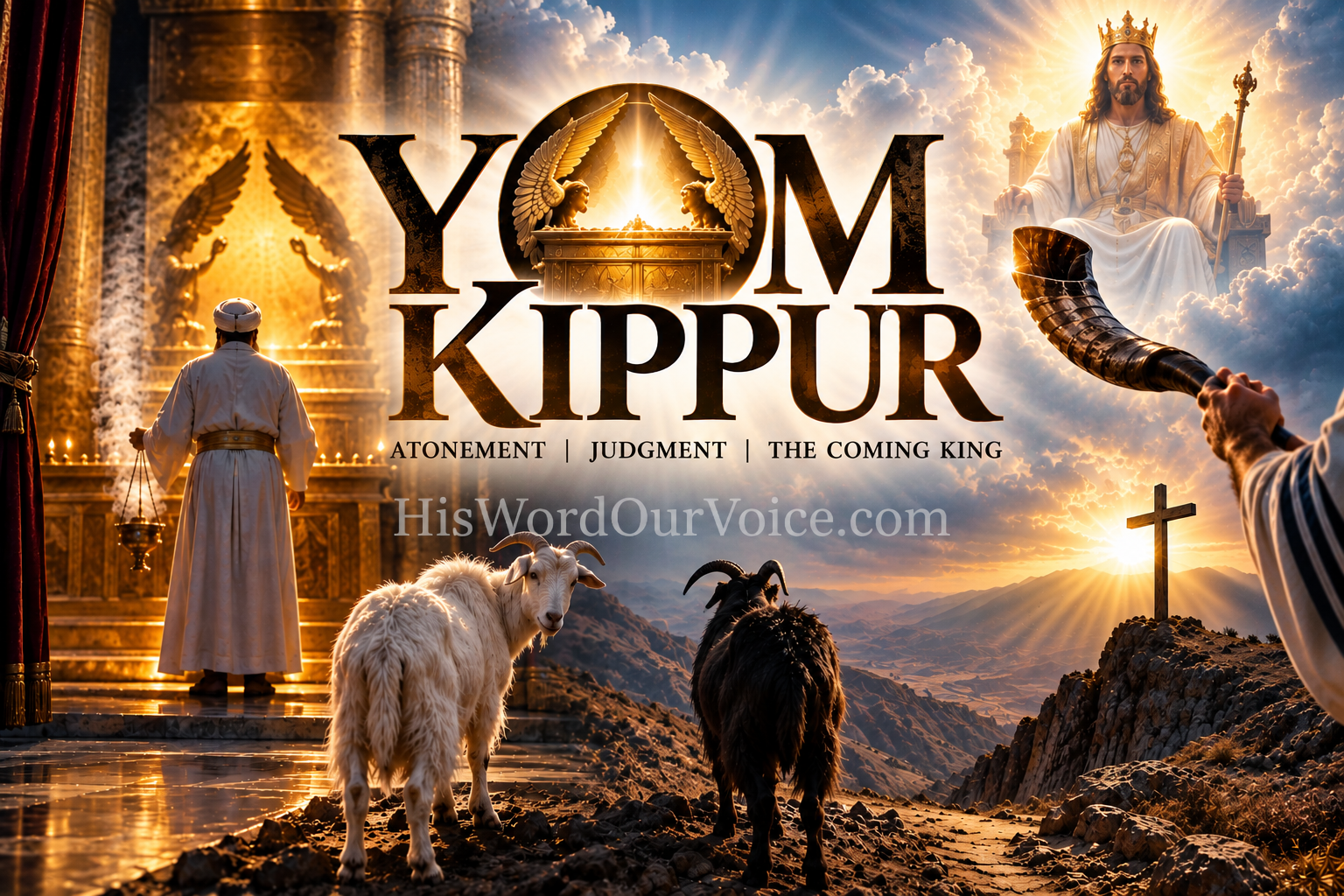
Yom Kippur—the Day of Atonement—is the most solemn appointed day in the biblical calendar. Established by God in Leviticus 16 and commanded as an appointed time in Leviticus 23:26–32, it was the one day each year when the High Priest entered the Most Holy Place to make atonement for the sins of Israel.
The Day of Atonement
Two goats stood at the center of the ceremony.
One was sacrificed as a sin offering, and its blood was brought behind the veil and sprinkled on the mercy seat. Over the second—the scapegoat—the High Priest confessed the sins of Israel before it was sent away into the wilderness, symbolically carrying away the people’s iniquities (Leviticus 16:15–22).
Together, the images are striking:
Sin requires atonement.
Blood is shed.
Guilt is carried away.
A holy God provides the way for His people to be reconciled to Him.
Yet these sacrifices had to be repeated year after year.
They were pointing toward something greater.
Yom Kippur and Jesus
The book of Hebrews directly connects the imagery of the Day of Atonement with the work of Jesus Messiah:
“But when Messiah appeared as Kohen Gadol of the good things that have now come… He entered into the Holies once for all—not by the blood of goats and calves but by His own blood, having obtained eternal redemption.”
Hebrews 9:11–12 TLV
Jesus accomplished what the repeated sacrifices could never permanently accomplish.
He became both our great High Priest and the once-for-all sacrifice for sin (Hebrews 9:24–28; 10:11–14). He did not enter an earthly sanctuary carrying the blood of another. He offered His own life and entered the heavenly sanctuary on our behalf.
The imagery of sin being carried away also finds a powerful fulfillment in Messiah:
“He Himself bore our sins in His body on the tree.”
1 Peter 2:24 TLV
And when Jesus died, something extraordinary happened:
The veil of the Temple was torn from top to bottom (Matthew 27:50–51).
The barrier guarding the Most Holy Place had been opened. Hebrews therefore gives believers an astonishing invitation: because of the blood of Jesus, we may now enter the Holy Place with confidence (Hebrews 10:19–22).
The blood has been offered.
The sin has been borne away.
The veil has been opened.
The sacrifice does not need to be repeated.
“For by one offering He has perfected forever those being made holy.”
Hebrews 10:14 TLV
But Yom Kippur Also Carries a Warning
Yom Kippur was not merely about sacrifice. It was a solemn summons to humble oneself before God.
God commanded Israel:
“It is a Day of Atonement, to make atonement for you before ADONAI your God. Anyone who does not deny himself on that day must be cut off from his people.”
Leviticus 23:28–29 TLV
Atonement was graciously provided by God, but His people were called to respond with humility and repentance.
This introduces another biblical theme associated with Yom Kippur:
Judgment.
God is merciful, but He is also holy. Sin cannot simply be ignored. Either atonement must be made for sin, or the sinner remains accountable before God.
The New Testament carries the same urgency:
“God is now commanding all people everywhere to repent, because He has set a day on which He will judge the world in righteousness.”
Acts 17:30–31 TLV
There is a day of judgment coming. Prayer portions for repentance can be found here!
And remarkably, the book of Hebrews connects this reality directly to its discussion of Christ’s fulfillment of the Day of Atonement.
Atonement, Judgment, and His Return
After describing Jesus entering the heavenly sanctuary and offering Himself once for sin, Hebrews declares:
“And just as it is appointed for men to die once, and after this judgment, so also Messiah was offered once to bear the sins of many. He will appear a second time… for the salvation of those eagerly awaiting Him.”
Hebrews 9:27–28 TLV
The progression is striking:
Yom Kippur → Atonement → Judgment → Messiah’s Return
At His first coming, Jesus appeared to deal with sin through His sacrifice.
At His second appearing, He returns as the victorious King.
The One who provided atonement is also the One through whom God will judge the world (Acts 17:31).
Yet for those who belong to Messiah, there is extraordinary hope:
“Therefore, there is now no condemnation for those who are in Messiah Yeshua.”
Romans 8:1 TLV
The Judge is also the One who bore our sin.
What About the “Books Being Sealed” on Yom Kippur?
Later Jewish tradition developed the idea that during the period beginning with Rosh Hashanah, heavenly books are opened and that on Yom Kippur one’s judgment for the coming year is sealed.
This imagery is fascinating because Scripture certainly speaks about heavenly books, the Book of Life, and a coming judgment (Daniel 7:10; Daniel 12:1; Revelation 20:11–15).
However, an important distinction should be made:
The specific teaching that the books are opened on Rosh Hashanah and sealed on Yom Kippur is later Jewish tradition; it is not explicitly taught in the Torah.
The biblical message itself is already powerful enough.
There is a Book of Life.
There is a coming judgment.
There is a holy God before whom humanity will stand.
And there is an atonement God Himself has provided.
The Jubilee Connection
Yom Kippur also carries a remarkable connection to Jubilee. Every fiftieth year, on the Day of Atonement, a shofar was to sound throughout the land, proclaiming liberty: property was restored and people returned to their inheritance and families (Leviticus 25:9–10). Significantly, liberty was proclaimed on the very day of atonement. For the Christian, the imagery is powerful: through Messiah’s atoning work comes freedom, restoration, and the recovery of what was lost. Jesus Himself announced that He had come “to proclaim release to the captives” and “the year of ADONAI’s favor” (Luke 4:18–19; Isaiah 61:1–2). Yom Kippur therefore points not only to sin being forgiven, but toward the greater restoration made possible through Messiah: atonement opens the way for liberty.
The Christian Significance of Yom Kippur
For followers of Jesus, Yom Kippur is therefore far more than an ancient ceremony.
It is a prophetic portrait of the Gospel.
It reminds us of the seriousness of sin, the holiness of God, the necessity of atonement, the call to repentance, and the extraordinary sufficiency of the sacrifice of Jesus.
The Day of Atonement ultimately points beyond the blood of bulls and goats to the Lamb who offered Himself once for all.
And it points forward—to the day when Messiah will appear again.
At His first coming, He bore our sin.
At His second coming, He will appear again.
Between those two realities stands the invitation: repent, receive His atonement, and be reconciled to God.
Yom Kippur reminds us that judgment is real.
But so is mercy.
And God Himself has provided the atonement.
Leave a Reply